
A letter to the traveler scrolling Klook at 1 a.m., wondering why every date in late July is grey — and what the grey is actually telling you.
You will land in Đà Nẵng on a humid Tuesday in late July or early August. Your hotel is in Hải Châu. You have a list, and “Sun World Ba Na Hills” sits near the top of it because that is what the algorithm has been feeding you for six weeks — the Golden Bridge, the giant stone hands, the cable car. You will open Klook one more time before bed, and the calendar will look the same as it looked yesterday: half the days greyed out, the rest priced higher than you expected. You will feel a small pulse of panic that the trip is already going wrong before you have boarded the plane. And underneath that panic, something quieter — a question you cannot quite finish — what if the version of Đà Nẵng I came to see is not actually up there at all?
Hold that question. We will come back to it.
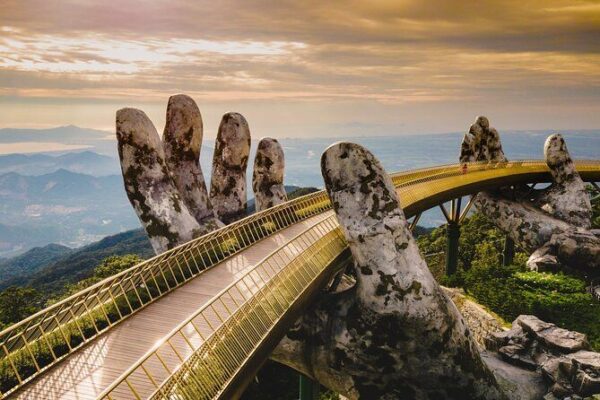
I have lived along this stretch of central Vietnam — between Đà Nẵng and Hội An — for several years. I have ridden the Bà Nà cable car eight times, six of them with foreign friends I love who asked me to take them. I have eaten the buffet. I have stood on the Golden Bridge at 11:14 a.m. with two hundred other people. I have been wrong about this mountain more often than I have been right. So before we talk about your dates and your buffet and your Grab car, let me tell you what nobody on Reddit will tell you, because they are still trying to be polite.
The grey dates on Klook are not what you think they are
The first thing — your real question, hidden under the others. You are not asking “are these dates sold out.” You are asking “is the trip already broken before I land.” Let me unbreak it.
When dates go grey on a Klook listing for Sun World Ba Na Hills, nine times out of ten the park itself is open. The park runs daily from 8:00 AM to 5:00 PM, including through July and August — high season for domestic and Korean tourists, which is why the OTAs flicker. What goes grey is the inventory the OTA has been allocated for that specific package on that specific day — the combo with buffet, the WOW Pass tier, the bus-included version. The park has not closed. Klook’s slice has run out, or the partner who packages that combo has paused it. Two different things.
Here is what to actually do, in the flat practical voice this needs:
1. Try Traveloka, KKday, and Agoda for the same date. Different OTAs hold different allotments. A date grey on Klook is often available on a competitor by morning.
2. Check the official Sun World website directly (banahills.sunworld.vn). They run their own ticket pool that the OTAs do not see.
3. Yes, you can buy at the counter the same day. The ticket booth at the lower cable car station sells walk-up entry. You will pay the same or slightly more than online. The risk is queueing in the sun for thirty to ninety minutes during peak season — late July is peak season — and on the rare day the park caps entry, getting turned away after a 40-minute taxi ride.
4. If you absolutely want a guaranteed date, book the bare entry+cable-car ticket online first. Add the buffet at the buffet desk on the mountain itself. Splitting the booking unsticks most grey-date problems instantly.
Now. The second question you asked. Whether to bother with the buffet at all.
The “International Lunch Buffet” — what it is, and what it is not
I will be plainer than the reviews are. The Four Seasons buffet at Ba Na Hills is a logistics convenience, not a meal. It opened in April 2023, serves up to 90 dishes across Asian and European categories, and is included in most combo tickets for around 300,000 VND extra per person. It is also, on a peak-season day, a room of nine hundred people moving in three directions at once, food trays refilled at a speed slightly slower than they are emptied, and dishes that — as more than one Tripadvisor reviewer has noticed — cool faster than they are replenished.
Read the recent reviews. The same word keeps surfacing: lukewarm. Crispy fries occasionally. Bread that is reliably good. A tour guide on Reddit recently summarised it in seven words and I am paraphrasing him: eat a big breakfast, skip the buffet, eat a real dinner in town. That is the most useful sentence anyone will write about Bà Nà food this year.
Are there alternatives on the mountain? Yes. There are five or six other buffet rooms — Bharata for Indian, Beer Plaza, Taiga, Little Tokyo — at similar prices and similar quality, which is to say, similar ceilings. There are à la carte spots in the French Village that cost more for less. There is no restaurant on Ba Na Hills that you will remember in two months. That is not a complaint. That is the nature of food cooked at scale 1,487 metres above sea level for an audience that turns over every four hours.
So here is what I would do, if you were my sister and you had asked.
Skip the buffet combo. Bring a small backpack with bottled water, a banh mi from a stall in Hải Châu, and two pieces of fruit. Eat your real lunch on the mountain at 11:30 a.m. on a bench overlooking the karst valley. Save your appetite for dinner — for a proper dinner — back at sea level.
This single decision will change the shape of your day on Bà Nà more than any Wow Pass upgrade will.
Hải Châu to Bà Nà and back — the Grab question, and the trap inside it
Yes, Grab works. The ride from Hải Châu to the lower cable-car station is roughly 25 to 30 kilometres, 30 to 45 minutes on a good morning, 180,000 to 280,000 VND in a Grab car depending on time of day and demand surcharge. Grab Bike is cheaper but I would not recommend it for two passengers with bags, on a road that climbs and curves, in afternoon rain. Mai Linh and Vinasun taxis are reliable from city to mountain — yellow and green and white respectively, ask for the meter.
The trap is the return.
Drivers do not loiter at Bà Nà. Grab availability at the base station between 4:30 and 6:00 p.m. — when every visitor descends at once — collapses. You will stand in a queue of foreign tourists watching the same three icons appear and disappear on your phone. I have watched a French couple wait fifty minutes for a ride home; I have done it myself once. The fix is unromantic but flawless: book the round-trip with the same driver from the morning. Pay him 600,000 to 800,000 VND total to wait. Most are happy to. He will sleep in the car park, eat his lunch, and be standing at the gate when you walk out. Ask your hotel front desk to arrange this the night before. Hải Châu hotels do this every day.
But — and now I have to ask the harder question — is this the trip you came for at all?
What Sarah from Manchester taught me about Bà Nà
Two summers ago, a reader I will call Sarah — early forties, Manchester, two weeks in Vietnam, husband on a sabbatical — wrote to me asking essentially what you are asking. Klook dates, Grab logistics, buffet worth it. I gave her the same flat answers I have just given you. They went on the Tuesday. The day was thirty-four degrees in the city; on the mountain it was twenty-one and clear. They stood on the Golden Bridge for the photograph. They ate the buffet. They were home by six.
She wrote me back four days later. The email opened with a line I have not been able to forget. We did everything right and we still came home from Bà Nà sad, and we cannot work out why.
Here is why. You can do Bà Nà perfectly — the right ticket, the right Grab, the right buffet hack — and still feel, at the end, that you have been to a stage set built for someone else’s photograph. The Golden Bridge was opened in 2018. The hands are six years old. The “French Village” is a recreation of a place that never existed. None of which makes it bad. All of which makes it not the thing you crossed an ocean for.
Sarah’s second day in central Vietnam, by accident, became the day she remembered. They got lost on the back roads between Đà Nẵng and Hội An, ended up at a small farm-kitchen in a village she could not pronounce, ate a meal that had been growing in the ground that morning, and watched a woman in her sixties teach her husband — her husband, who had not cooked in eleven years — how to wrap a spring roll. They paid less for that whole afternoon than they had for the buffet at the top of the mountain.
She wrote: I came for the bridge. I am going home talking about the spring rolls.
That is the pattern. Not unique. Not Sarah’s alone. The traveler who comes to central Vietnam for Bà Nà and leaves changed by something else — that is the most common story I have collected in eight years of writing this letter.
What you actually came for (and where it still lives)
Anthony Bourdain once said of this country, in a single line that has done more for Vietnam tourism than any government campaign: “Vietnam. It grabs you and doesn’t let you go.” He filmed eight episodes here over fourteen years. None of them were on top of a manufactured mountain. He shot Bourdain-Vietnam at sidewalk plastic stools, in fishing villages, in the kitchens of women whose names you would not recognise. He understood something the brochure cannot tell you, which is that the Vietnam you came for is not on a list. It is on a side road off the list.
You will be tempted to think I am romanticising. Fair. Let me be specific instead.
When the heat in Đà Nẵng hits 36°C in early August and the city’s coastline is full of selfie-sticks and inflatable swans, the version of central Vietnam that still earns the word authentic is roughly five to twenty kilometres inland, in the small communes between Đà Nẵng and Hội An — Cẩm Thanh, Cẩm Kim, Hoa Vang’s lower villages — where rice paddies still meet vegetable gardens and the kitchens still cook from the morning’s market. Not “off the beaten path” in the marketing sense. Off the beaten path in the literal one. The buses do not turn down the lanes that lead to these places because the lanes are too narrow for buses.
A few specific things you can do instead of, or in addition to, half a day on Bà Nà:
• An afternoon at a working farm-stay near Hội An, where lunch is the four vegetables you helped pick from the garden an hour earlier. Cooking is not a “class” — it is a meal that two people made together, one of whom happens to have spent forty years making it.
• A 4:30 a.m. ride to Cồn Market in Đà Nẵng with a Vietnamese friend or hired guide. Watch the city wake up. Eat phở at a stall where the broth has been simmering since the night before. Be home at your hotel before the cruise tourists are at breakfast.
• A bicycle through the rice fields at Cẩm Thanh at 6:00 a.m. before the heat. Free. Bring 50,000 VND for a coconut from a roadside woman who will smile at you for the whole transaction.
These cost almost nothing. None of them are on a list of “Top 10 Things To Do.” That is precisely why they survive.
The small farm I will not say much about
There is a place I send people to when they ask me — quietly, the way you would ask a friend, not the way you would search Tripadvisor — where the longing I have spent this whole letter naming actually still lives. It is a small farm. It is called Cocolocal. The kitchen is run by people who learned cooking from their mothers, who learned from theirs. The bedrooms face a field, not a parking lot. They serve what the field grew that morning. The road in is narrow. The kitchen seats a small number of people because that is the size of the kitchen — that is not a marketing decision.
I am not going to give you a website link. I am not selling anything; I do not sell tours; I do not have a partnership and I never will. If you want to find Cocolocal, you will. The point is not the place. The point is that the kind of place it is — the family-table version of central Vietnam — still exists, twenty minutes from the cable car you were planning to spend the day on. The contrast is the lesson.
You will spend roughly the same on a quiet half-day at a farm like that as you would on the buffet-and-Wow-Pass combo at Bà Nà. You will come home with something the photograph could not carry.
One last gift, before you go
Here is the phrase that opens almost every door in central Vietnam, and that no tourist over the age of thirty seems to learn before they land. Use it before any question, anywhere, with anyone over twenty-five:
“Anh ơi…” (to a man, “older brother…”)
“Chị ơi…” (to a woman, “older sister…”)
Soft second tone on the ơi. It means hey, hello, excuse me, but underneath it means I see you as family. Watch what happens to the face of the woman selling you the coconut. Watch what happens to the Grab driver. Watch what happens, three days in, to your own face. The country opens to people who arrive with that one syllable in their mouth, and stays closed to people who don’t.
A reader from Sydney wrote to me last spring with one line that I think belongs at the end of this letter rather than the start: I came for the bridge. I stayed for the rice fields.
A tiny, internal call to action — the only kind I will ever ask of you
Open your Đà Nẵng itinerary. Find the day you have allocated to Sun World Ba Na Hills. Do not delete it. Half-delete it. Give the mountain four hours, not eight — early cable car up, the bridge, one buffet skip, one cable car down by 1 p.m. Take the Grab back to Hải Châu. Have a cold cà phê sữa đá at a sidewalk cafe. Then, with the afternoon you have just bought yourself, go five kilometres in the direction the tour buses do not go.
That is the trip. The grey dates on Klook were never the problem. The size of the day was the problem. You can fix that one tonight, before the plane has even taxied to its gate.
Travel well. Bring a reusable water bottle. Learn one more word.
Suggested related reads
• Hội An vs Hanoi — the Honest Comparison Most Articles Refuse to Make
• Is Halong Bay Worth It? A Five-Year Resident’s Answer
• Đà Nẵng in Five Days, Without the Tourist Bus — A Slow Itinerary
Image alt-text suggestions
5. “Sun World Ba Na Hills Golden Bridge with crowd in late July, Da Nang Vietnam”
6. “Cable car ascending to Sun World Ba Na Hills above Da Nang, peak summer”
7. “Quiet rice field five kilometres from Sun World Ba Na Hills — the other Da Nang”
8. “Vietnamese woman cooking spring rolls at small farm kitchen near Hội An”
9. “Empty back lane between Đà Nẵng and Hội An at sunrise, Vietnam off the beaten path”